 Innok Robotics
Innok Robotics GmbH Expands Its Executive Management Team: Michael Hanselmann Named New CFO
Innok Robotics GmbH Expands Executive Management: Michael Hanselmann Joins as Chief Financial Officer (CFO) Ahead of Planned Initial Public Offering
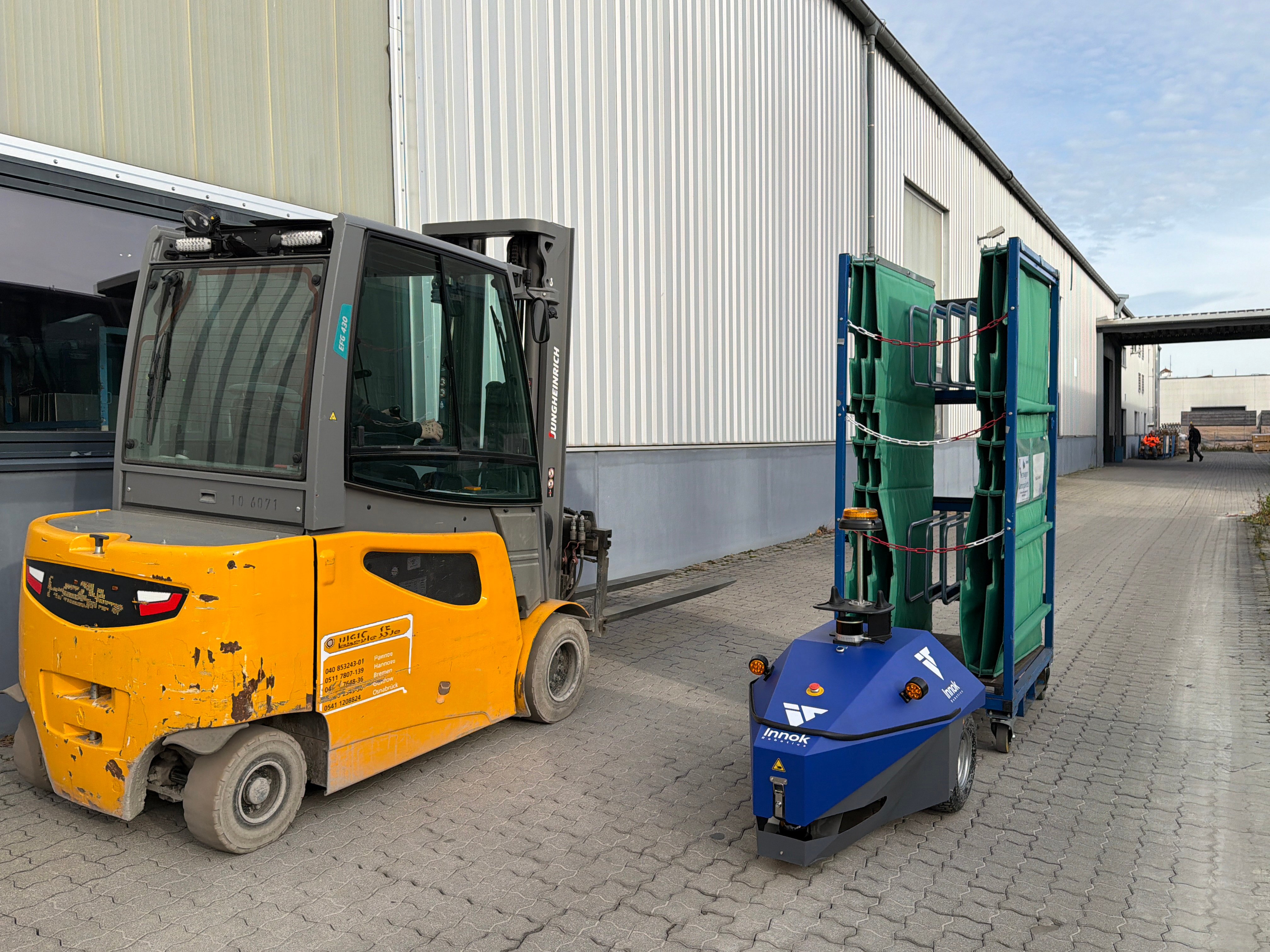
Forklift trucks are the workhorse of intralogistics in many companies. They move pallets, steel frames or pallet cages quickly from A to B, load trucks and supply production lines. At the same time, they are expensive to operate, require trained personnel, cause many trips through the warehouse and are repeatedly the focus of accident statistics.
This is precisely why many companies are looking for a forklift alternative: solutions that are cheaper, safer, space-saving or can be automated. Many guides focus on electric pallet trucks and highlifters. They are indeed an important alternative, but only part of the picture.
In this article, you will get a comprehensive overview: from manual and electric lifting devices to tugger trains, driverless transport systems and autonomous mobile robots that can replace traditional forklift truck movements indoors and outdoors. You will find out which forklift alternative suits which application profile and why automated transport robots in particular are playing an increasingly important role.
The forklift truck is widely used for good reason:
At the same time, the classic forklift truck has a number of disadvantages:
Forklift trucks are among the most accident-prone industrial trucks. Studies and accident statistics show that many thousands of reportable accidents involving forklift trucks occur every year, sometimes with serious or fatal consequences. The most common causes are collisions with people, the vehicle tipping over or insufficient visibility.
Driving a forklift requires a forklift license and written authorization, including regular training. In addition, drivers must be permanently available - a real challenge in times of a shortage of skilled workers and shift work.
Forklifts need clear routes, turning areas and safety distances. In established layouts, this quickly leads to conflicts with footpaths, rack aisles and machine zones.
Forklifts are often oversized for short distances, low lifting heights and many small transport jobs. Lighter systems such as pallet trucks or automated transport robots can be more efficient here.
If you are looking for a forklift alternative, it makes sense to start with the question: What specific tasks does the forklift truck perform today? This determines which alternative really fits the bill.
Typical alternatives to the classic counterbalance truck include
While many guides focus primarily on inexpensive alternatives such as electric pallet trucks, in the following we deliberately look at the entire spectrum - right up to solutions that can not only replace forklift truck journeys, but also fully automate them.
When it comes to classic forklift alternatives, electric pallet trucks and high lift trucks are mentioned most frequently. They are seen as a cost-effective and compact alternative, especially for:
Advantages of electric pallet trucks and high lift trucks
Limitations of this forklift alternative
Conclusion: Electric pallet trucks and high lift trucks are a sensible forklift alternative where the focus is on simple pallet transportation over short distances. As soon as processes become more complex, longer or more frequent, other alternatives become more interesting.
In many production plants, forklift trucks supply individual workstations or lines directly - often with many individual trips. Tugger trains take a different approach: they bundle material requirements and supply several stations on fixed routes and cycle times.
Advantages of tugger trains as a forklift alternative
Challenges
Especially if you currently have several forklifts in circulation that regularly travel the same routes, a tugger train concept can be a very effective forklift alternative - also as preparation for later automation.
A key trend in intralogistics is the automation of in-house transportation. Instead of constantly manned forklifts, driverless transport systems (AGVs) or autonomous transport robots are taking over recurring material movements.
Typical areas of application
Advantages compared to classic forklift operation
AGV/AGV vs. autonomous transport robots
Depending on the application profile, even a simple AGV can provide a significant improvement over forklift operation. In environments with frequent layout changes or mixed operations involving people and machines, autonomous transport robots are usually the more flexible forklift alternative.
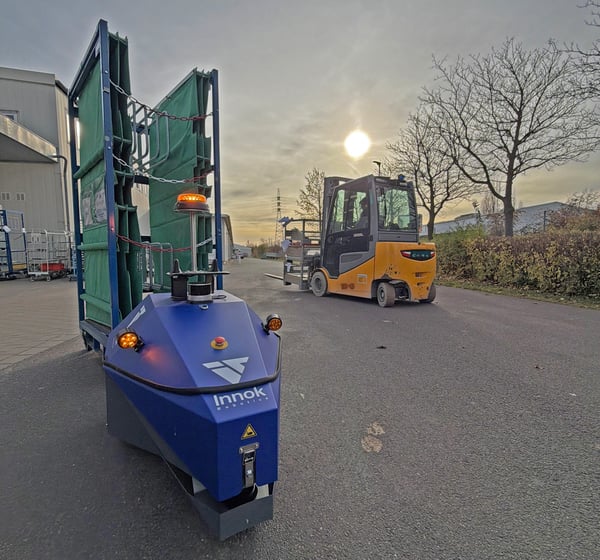
Many companies use their forklift trucks not only in the warehouse, but also outside buildings - for example between halls, to outdoor storage areas or in plant logistics with long distances. This is precisely where traditional indoor solutions reach their limits.
Outdoor-capable autonomous mobile robots (AMR) such as the INDUROS are designed to cover material flows across the entire factory premises:
A typical application for this type of forklift alternative:
Advantages of autonomous outdoor transport robots as a forklift alternative
In contrast to simple forklift alternatives such as electric pallet trucks, autonomous transport robots not only handle the load movement, but also the entire process chain consisting of order, transport, handover and feedback to control systems.
Whether a forklift alternative makes sense depends less on the technology than on the general conditions. The main influencing factors are
Typical effects of switching to forklift alternatives
Particularly in the case of autonomous transport robots, the economic efficiency analysis should go beyond pure acquisition costs:
In many cases, forklift alternatives - especially automated solutions - pay for themselves within a few years if they are consistently embedded in the overall material flow. A material flow analysis or a discussion with the experts at Innok Robotics can help with this consideration.
In order to find the right solution from the multitude of possible alternatives, a few steps have proven their worth:
A systematic material flow analysis reveals where many forklift truck journeys take place today, which routes are particularly busy and where automation would have the greatest effect.
Instead of abolishing all forklifts overnight, an iterative approach is a good idea:
With automated alternatives in particular, it is crucial how well solutions can be integrated into existing systems such as ERP, WMS or MES. Standardized interfaces and fleet managers help to orchestrate operations efficiently later on.
A forklift alternative is not a single machine, but a strategic decision for a different approach in intralogistics. The spectrum ranges from simple electric pallet trucks to tugger trains and fully automated transport robots that take over classic forklift truck movements indoors and outdoors.
In a nutshell:
For companies that are currently heavily dependent on forklift trucks, it is therefore worth looking at forklift truck alternatives twice over: they not only open up scope in terms of costs, safety and ergonomics, but are also the first step towards intelligently networked, largely autonomous intralogistics, in which the forklift truck only travels where it is really indispensable. The experts at Innok Robotics will be happy to help you analyze whether you can usefully replace forklift transports with an autonomous solution.
Innok Robotics GmbH Expands Executive Management: Michael Hanselmann Joins as Chief Financial Officer (CFO) Ahead of Planned Initial Public Offering
Reducing CO2 Emissions in Intralogistics: Where Emissions Occur and How Much Automation Really HelpsEmission factors, calculation examples, and...
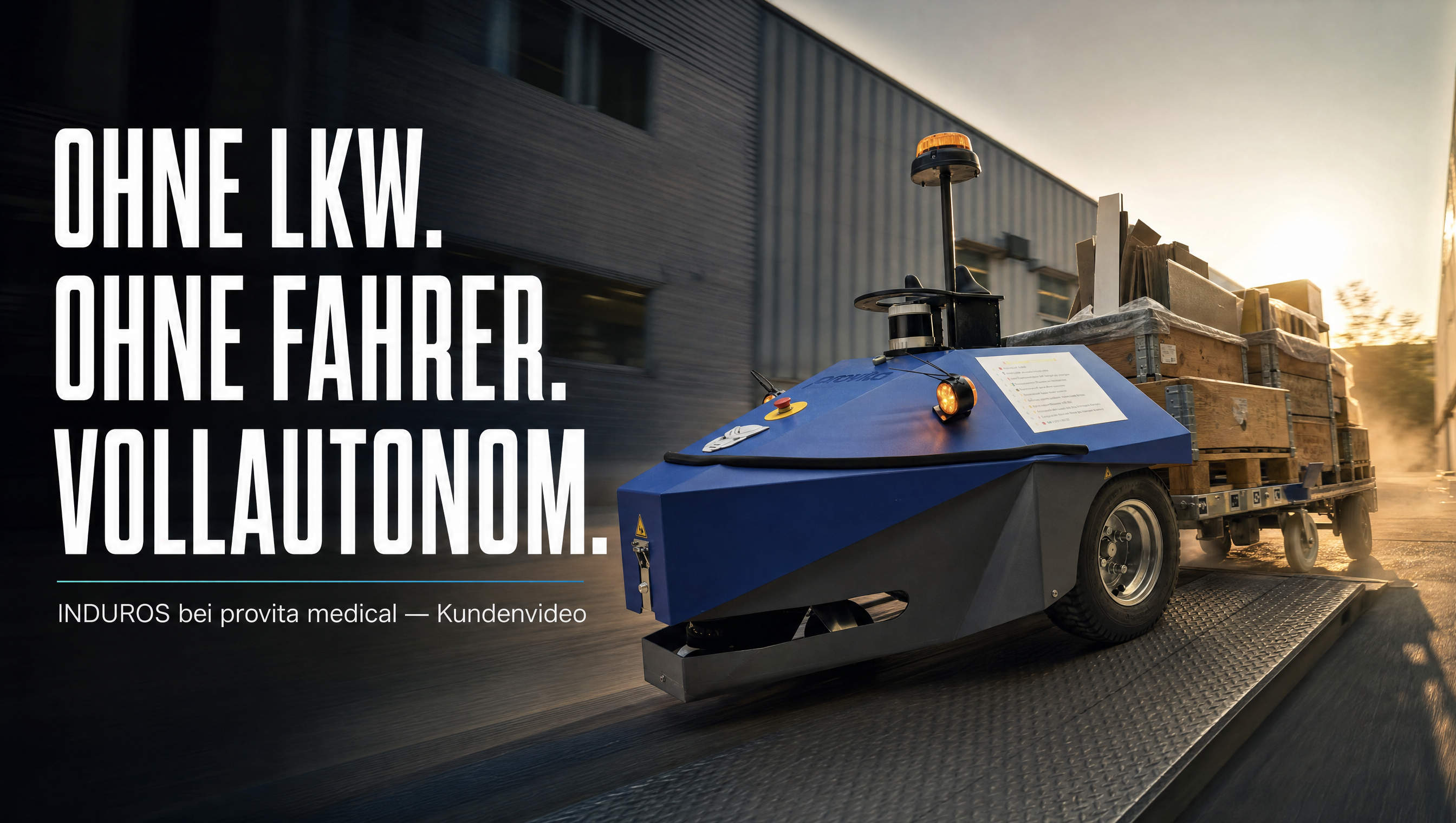
The Latest Innok Case Study: INDUROS Automates Cross-Plant Logistics at provita medical