 Innok Robotics
Innok Robotics in the New Hidden Champions Trend Report
Innok Robotics in the New Hidden Champions Trend Report: A Pioneer in the Key Area of Robotics.
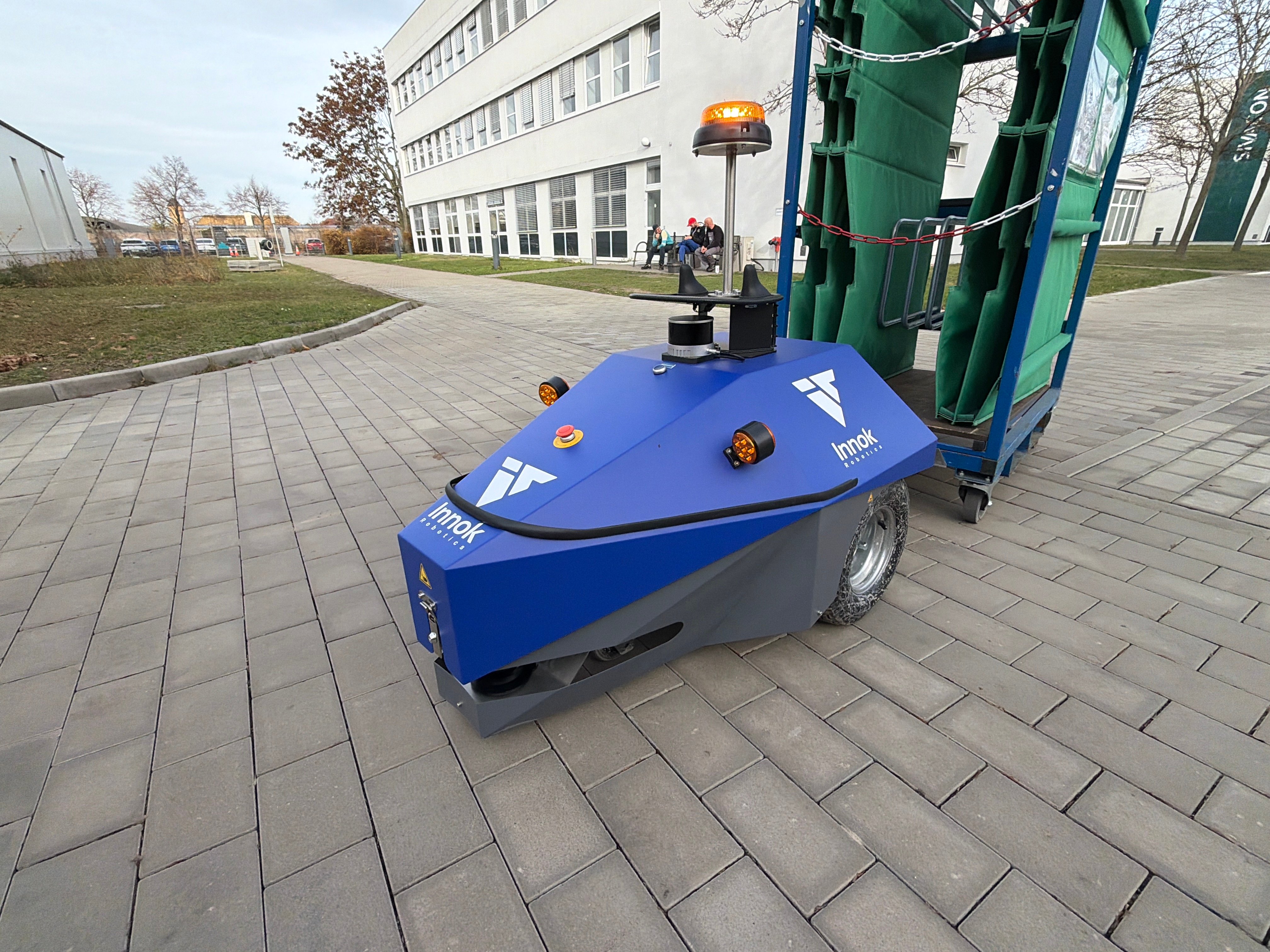
AMR Autonomous mobile robots have become a standard component of modern intralogistics in just a few years - market growth of up to 62.5 percent per year. Manufacturers promise flexible, infrastructure-free and intelligent alternatives to traditional automated guided vehicles (AGVs). But what exactly are the facts? This guide answers the questions most frequently asked by users today: What exactly are AMR Autonomous Mobile Robots, how do they work technically, where do they differ from AGVs and AGVs, what do they cost, when do they pay for themselves and in which use cases are they actually worthwhile? You will receive a sober, data-supported classification - including the pitfalls that lurk in throughput systems and a clear recommendation for indoor, outdoor and brownfield scenarios.
1 What are AMR Autonomous Mobile Robots?
2 How do AMR Autonomous Mobile Robots work technically?
3. AMR vs. AGV and AGVs - what is the real difference?
4 Autonomy is not the same as automation
5 Which autonomous functions really make sense today?
6 Which industries and applications use AMR?
7. Indoor, outdoor or brownfield - which AMR classes are there?
8 Where should caution be exercised? AMR in throughput systems
9. Advantages and disadvantages of AMR at a glance
10. What does an AMR cost? Acquisition, TCO and ROI
11. Safety and standards: VDA 5050, ISO 3691-4
12 How do I introduce AMR? Prerequisites and implementation steps
13. Selection criteria: What you should look for in a provider
14 Conclusion: Using AMR with a sense of proportion and the right class
The term AMR autonomous mobile robots describes floor-bound mobile robots that transport materials independently in intralogistics. In contrast to conventional guided vehicles, AMRs navigate on the basis of a digital map, sensory perception and algorithmic path planning. If required, they can avoid obstacles, dynamically adapt routes and could therefore make decisions independently within a limited framework.
It is important to make a sober classification: AMR autonomous mobile robots are not a separate technological "species" that replaces the classic automated guided vehicle system (AGV). They belong to the same family of floor-bound intralogistics transport vehicles - only with additional autonomous functions. For this reason, the relevant VDI technical committees and relevant standard works such as the "AGV Primer" consistently refer to "mobile robotics" and treat AGVs, AGVs and AMRs in the same terminology. A modern AMR vehicle is often a highly automated automated guided vehicle (AGV) with an extended range of functions.
The central technology behind modern AMR autonomous mobile robots is SLAM - Simultaneous Localization and Mapping. SLAM algorithms create a map of the environment and simultaneously determine the position of the robot on this map. This eliminates the need for fixed guidelines, magnetic strips or reflectors.
Today, 3D LiDAR is almost always used as the primary sensor. A 3D LiDAR scanner generates volumetric point clouds by scanning several laser planes simultaneously and can create highly precise maps of surfaces. In practice, high-performance AMR systems combine the 3D LiDAR with other sensors - inertial measurement unit (IMU), odometry, optional GPS or RTK-GNSS and cameras. This sensor fusion is crucial because no single sensor source is reliable in every environment: GPS disappears in halls, LiDAR alone can lose its orientation on large outdoor areas, cameras suffer in poor lighting.
In the best case scenario, the result is hybrid navigation that reliably locates the vehicle even in rain, snow, cracked asphalt or when moving between the hall and yard. On this basis, a modern AMR plans its paths dynamically and can process several tasks sequentially or prioritized. All this is supplemented by autonomy software that receives orders, controls trailer coupling and uncoupling processes and loading processes and can be optionally integrated into a manufacturer-independent fleet manager via a VDA 5050 interface.
This is by far the most frequently asked question on the subject. If you want to use AMR autonomous mobile robots sensibly, you need to make a clear distinction between four terms:
The popular narrative is that AGVs follow fixed routes and come to a standstill in the event of obstacles, while AMRs navigate freely and take evasive action. In practice, the transitions are fluid. Modern AGVs have long been equipped with reactive obstacle avoidance; many AMRs continue to follow fixed routes in high-frequency areas for reasons of efficiency. Anyone who presents AMR autonomous mobile robots as a "better AGV" is simplifying reality.
This is a key misunderstanding. Automation means that a machine processes predefined sequences in a repeatable manner - something that classic AGVs have been doing reliably for decades. Autonomy goes one step further: the vehicle makes decisions independently based on current sensor data and a model of the environment.
Autonomous functions increase flexibility, robustness and ease of use. At the same time, they make predictability more difficult: when exactly a mission will be completed now depends more on environmental factors. In terms of safety, this means that each autonomous function must be evaluated, validated and approved separately - with consequences for the specifications. Use autonomy where it provides demonstrable benefits and avoid it where strict timing and repeatability are important. AMR Autonomous mobile robots are not an end in themselves.
In practice, some autonomous functions have proven to be particularly robust. They are technically mature and deliver measurable added value:
Important: these functions can be used on a modular basis. Not every application needs every function. A well-planned project uses autonomy as a tool - not as an end in itself.
An autonomous function with a focus on efficiency is, for example, the return transport of empty pallets on trailers. An AMR recognizes which pallets have already been unloaded in the warehouse, for example, couples these trailers autonomously and transports them back to production or pre-assembly, where they are needed again. The trailers are also parked there in a space that the robot recognizes as available and not in one that has only been permanently assigned in advance.
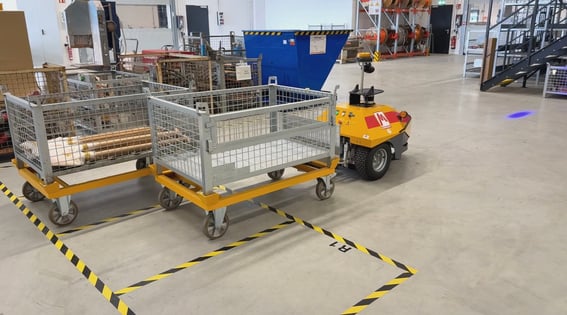
AMR autonomous mobile robots are used in almost all industrial sectors today. The most common fields of application:
Market observers such as Quadrant Knowledge Solutions see the AMR market as one of the most dynamic areas of industrial automation, with annual growth rates of up to 62.5 percent.
An often overlooked point when making a selection: Not every AMR is suitable for every application. You should differentiate between three classes:
Indoor AMRs are the largest and oldest class. They work in clean, air-conditioned halls with a level floor and are usually designed for storage and assembly. Well-known representatives are indoor platforms from large manufacturers, which often have protection class IP54 and speeds of up to around 2 m/s.
Outdoor AMRs are less common, but are indispensable for industry with factory premises. They have IP65 protection, all-weather sensors, more robust drives and higher ground clearance. They can master gradients of up to ten percent and navigate on gravel, paving or cracked asphalt.
Brownfield AMRs are the premier class: they can cope with the existing, often sub-optimal infrastructure in existing plants. Thresholds, ramps, old hall floors and the change between indoor and outdoor are their specialty. Hybrid navigation and IP65 protection are mandatory here. This class addresses precisely those industrial companies that want to automate their material flows end-to-end without having to rebuild their halls.
Anyone wishing to procure AMR autonomous mobile robots should first of all clarify which of these classes their own application lies in - the requirements for hardware, sensors and software differ considerably.
The opposite side is part of an honest consideration. In classic throughput systems - such as high-frequency indoor production lines with synchronized material changes - autonomous functions can actually worsen overall performance. If each vehicle makes its own decisions, the predictability of the system suffers. Traffic jams, waiting times and unclear handovers are the result.
Classic AGVs or AMRs with fixed routes, centralized control and disciplined handovers are often the more economical solution in such scenarios. This realization has now become established - also and especially through critical expert debates in the VDI committees and the relevant technical literature. Anyone who imposes autonomy across the board on all use cases is giving away performance and availability. First define the use case, then the required level of autonomy.
A balanced view encompasses both sides.
Advantages of AMR Autonomous Mobile Robots:
Disadvantages and challenges:
In terms of cost-effectiveness, it is worth looking at the total cost of ownership (TCO) over five to seven years - acquisition, maintenance, energy, software updates, training. Studies and practical references show that a single AMR vehicle in multi-shift operation typically achieves its ROI in 12 to 24 months. Concrete industrial companies report savings of around 60,000 euros per year in single-shift operation, around 120,000 euros in two-shift operation and up to 180,000 euros in three-shift operation per vehicle. In contrast, classic AGVs often only achieve their ROI after three to five years.
As an alternative to purchasing, many providers offer Robots-as-a-Service (RaaS) with a zero CAPEX approach: a fixed monthly rate including maintenance and software updates, but no classic investment block. This model often pays for itself from day one because the monthly rate is lower than the full costs of operating a manual forklift truck.
Anyone who introduces AMR Autonomous Mobile Robots seriously knows the most important reference points:
The VDI expert committees are also working on updated guidelines on autonomy, as many safety and acceptance issues can only be partially covered by conventional procedures.
A proven implementation roadmap is roughly divided into three phases, which you will also find in current industry guidelines:
The most important prerequisites on site: sufficiently dimensioned driveways (usually from 1.2 m wide, depending on the vehicle), power supply for charging or wireless charging stations, free wireless networks (WLAN or LTE) with sufficient coverage and an open software architecture that enables VDA 5050 compliance if the vehicle is not to be operated with the manufacturer's own software.
Change management is critical to success: AMR autonomous mobile robots change work routines. Those who involve the workforce at an early stage, offer training and use simple user interfaces such as tablet-based order initiation based on the cab principle will achieve a high level of acceptance and faster scaling.
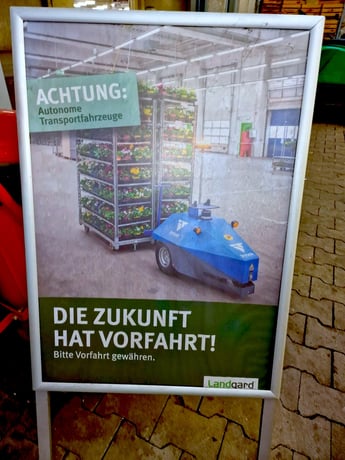
The AMR provider market has become confusing - dozens of manufacturers are active in German-speaking countries alone. These five criteria will help you make the right choice:
AMR autonomous mobile robots have a firm place in intralogistics - but not everywhere the same. In brownfield locations, when switching between indoor and outdoor, with mixed traffic and changing layouts, they play to their strengths. In high-frequency indoor throughput systems, classic AGV concepts often remain a good alternative to AMR on fixed routes. The key task is to clearly describe the use case, select the right AMR class and only procure those autonomous functions that deliver demonstrable added value.
Innok Robotics addresses this with the INDUROS exactly the market segment in which autonomous functions are indispensable: Outdoor and brownfield intralogistics with seamless transition between hall and yard. The vehicle combines IP65 protection, hybrid sensor fusion of 3D LiDAR, odometry and optional GPS, AI-supported reversing with trailer, autonomous control of gates and elevators, inductive wireless charging and VDA 5050 compliance. Several years of reference customers in the plastics/chemical, automotive and mechanical engineering industries confirm technical availabilities of up to 99.9% and an ROI of well under two years - proof that AMR autonomous mobile robots are a reliable component of modern material flows where they really come into their own.
If you want to check whether an AMR deployment makes sense for your plant, an honest use case analysis with a subsequent ROI analysis over four to five years is worthwhile. After a few hours of project discussions, it often becomes clear whether a classic AGV, an indoor AMR or an outdoor-capable brownfield AMR is the right answer and which autonomous functions you actually need to make your intralogistics more efficient, plannable and future-proof.
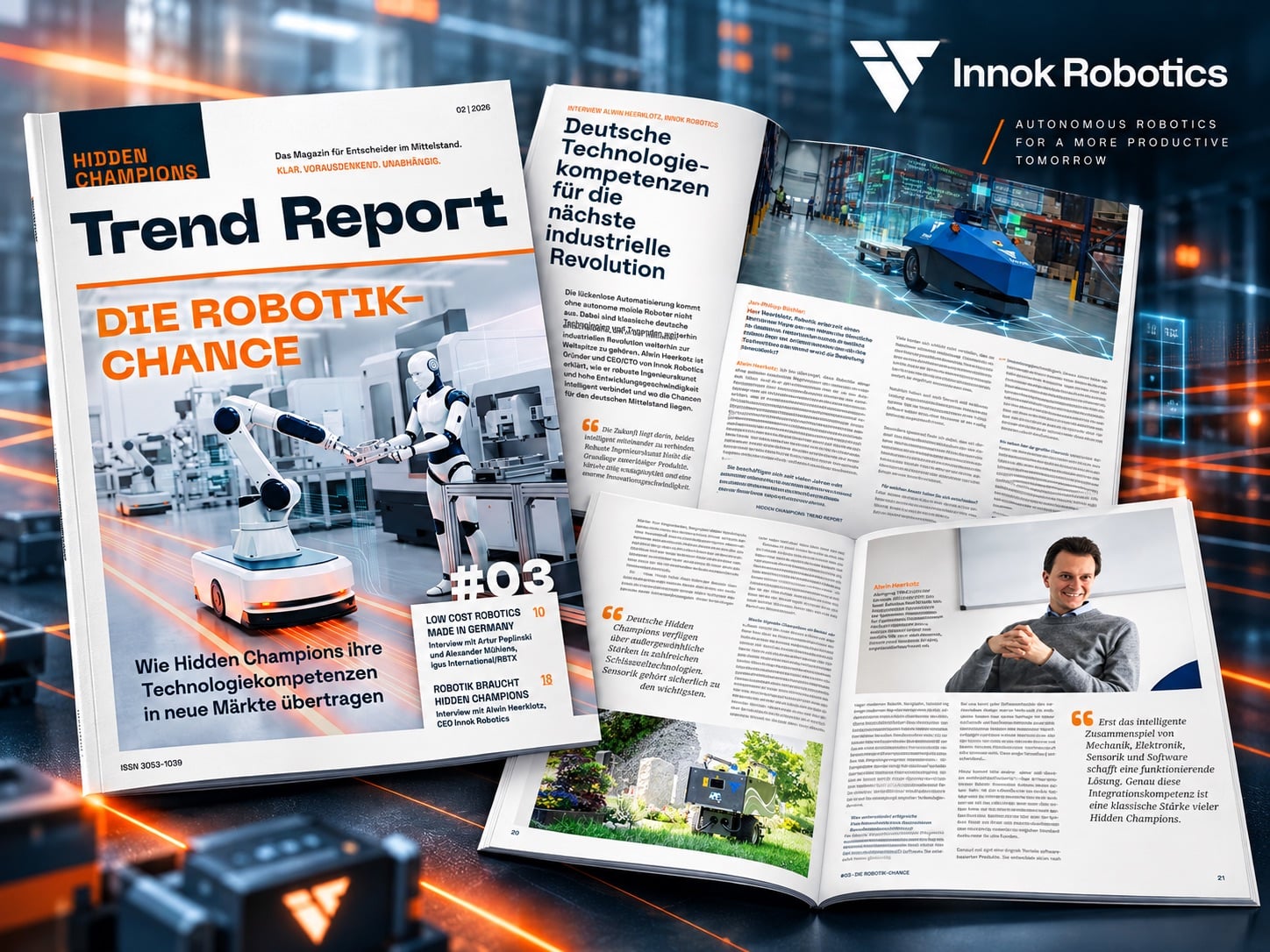
Innok Robotics in the New Hidden Champions Trend Report: A Pioneer in the Key Area of Robotics.
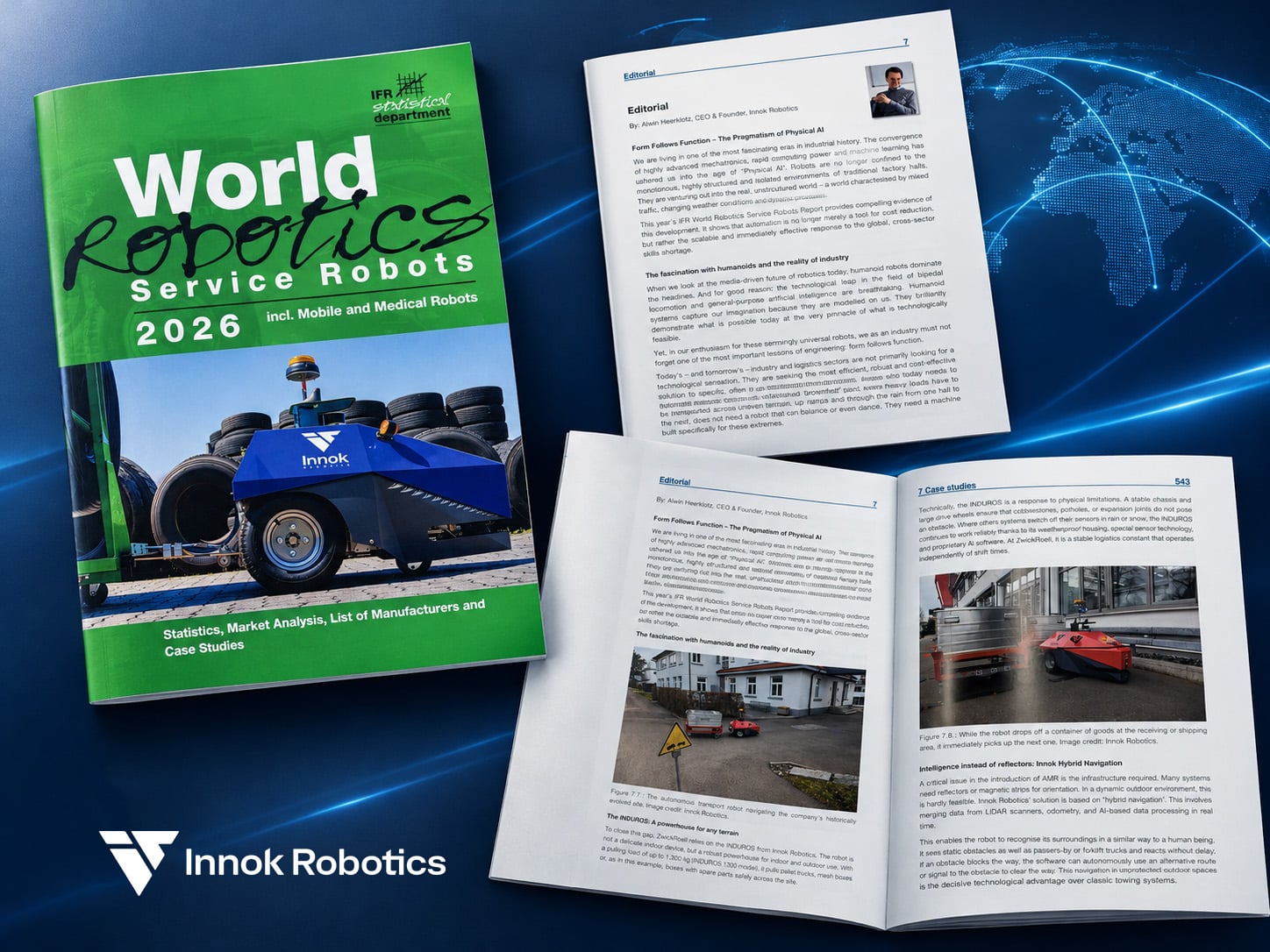
The International Federation of Robotics (IFR) has published this year’s World Robotics Service Robots Report. We are pleased that Innok Robotics...
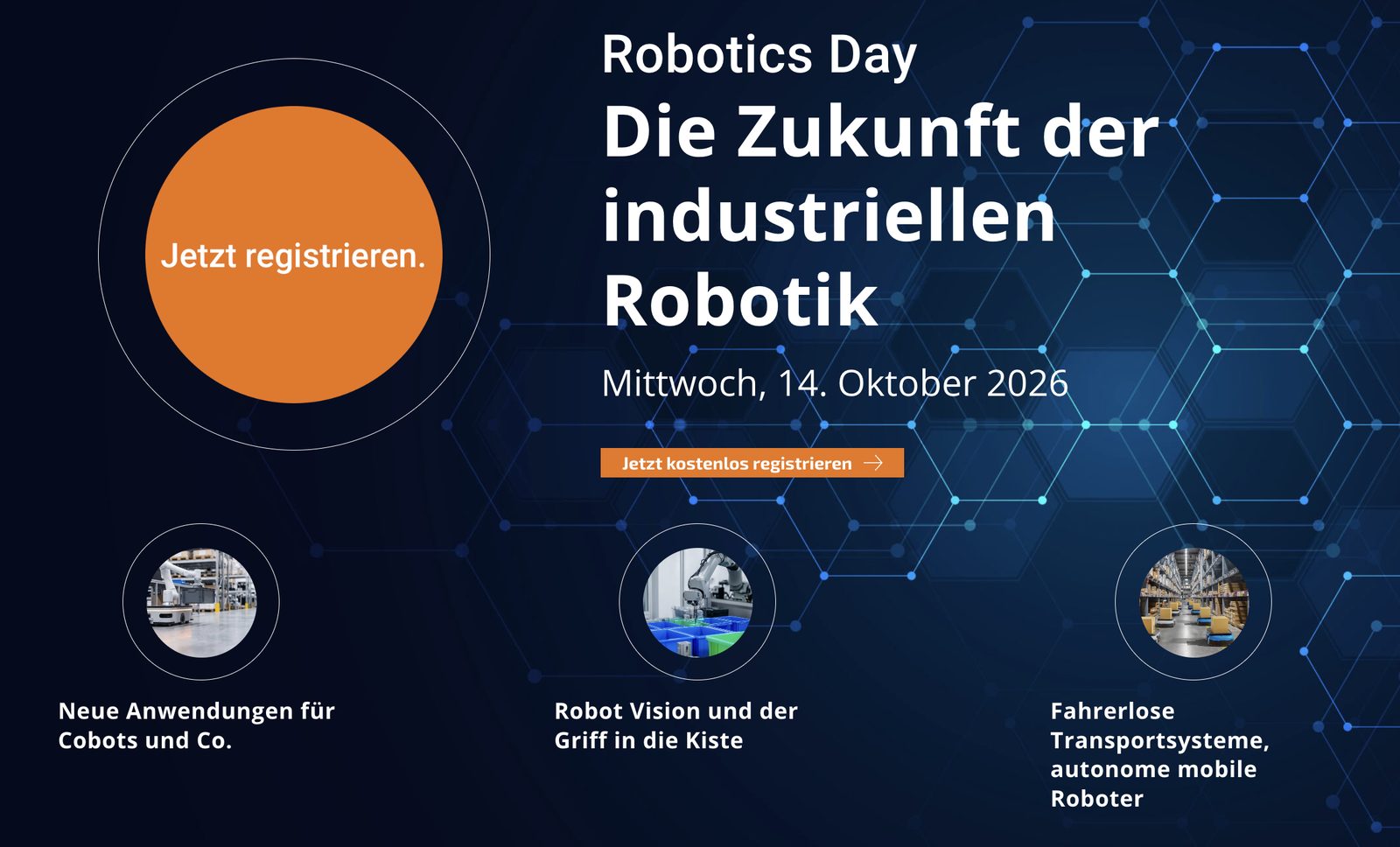
On October 14, CEO Alwin Heerklotz will represent Innok Robotics at the digital Robotics Day hosted by *Robotik und Produktion* magazine.